
|
| Radiomaster GX12 |
Once in a while a transmitter comes along which is different and interesting, and it’s this kind of radio that I love to review.
Enter the Radiomaster GX12 - small in size yet with several novel features, including gimbals with 3D Hall sensors, and support for Gemini transmission modes.
But just how good is the GX12 for sailplane and electric applications? And what are the benefits, if any, of Gemini? Read on and find out!
Unboxing
First impressions of the GX12 are warm and cosy - it comes in a nice padded case! Inside the case there's a zipper pocket for accessories.
Also supplied are:
- Replacement switch panels
- Extra 2-pos switch and momentary switch
- USB cable
- Screen protector
- Stiffer set of springs
- Stickers
- Manual (very basic)
Styling and build quality
The GX12 is squat and dense - imagine a mini sumo wrestler, and you have the idea. The styling is striking - functional, yet slightly radical!

|
| The GX12 comes in a neat carry case |
Fit and finish are good, with the exception of the trims - these are a little rattly and don't have a particularly good feel.
The dual antennas are short and fold down when not in use. The antennas are for both 2.4 GHz and sub-900 MHz operation.
There's no carry handle on the GX12. Instead there’s a sturdy strap with a Radiomaster logo stitched on. It does the job and keeps the unit compact.
One nice detail is that the GX12 is perfectly stable when standing on its base.

|
| Top view. Centre ports are headphone jack, USB-C and DSC ports |
Ergonomics
I'm used to flying with a RadioMaster TX16S, and it took me a while to get used to the shape of the GX12. Compared with the TX16S the GX12 feels a little less secure in the hand, although things improve with a neck strap.
The sticks are well positioned, and stick spacing is generous being identical to the TX16S.
The switch legends are engraved in white and are easy to read - a welcome improvement on previous Radiomaster offerings.
Switches and rollers
The GX12 has a good complement of switches, comprising:
- 2 momentary buttons (SG, SH)
- 2 rollers (S1, S2)
- 4 switches (SB, SC, SE, SF). Swappable, two spare switches included.
- 2 'pad' style switches with LEDs. (SA, SD)
- Array of 6 switches with LEDs (SW1 - SW6)
SA, SD and SW1- 6 are configurable - more on this later.
Programming controls
The programming controls follow the usual RM convention. The programming buttons have a nice feel, though the roller is rather small.

|
| Programming controls |
Display
The monochrome OLED display is a generous size (57 x 29 mm). However resolution is a lowly 128*64, so graphical elements like curves can look a little blocky.
While the screen is easy to read indoors, it struggled badly in bright sunlight even with the brightness at maximum.

|
| OLED monochrome display |
Replaceable switch panel
Now here's a surprise, the clue being the Allen bolts in the switch panels:

|
| RH panel showing momentary (SH), 3-pos (SF, SC) and roller |
Unscrew the bolts, and lift off the panel, and voila - a daughter board with the following:
- 2 switches (removable, swappable)
- roller (removeable)
- momentary button (fixed)
Removeable switches
Each panel comes with two 3-position types already installed. However, Radiomaster thoughtfully provide alternative switches in the form of a 2-position switch and a momentary - these come in a separate bag.
Replacing a switch is just a question of removing one and plugging in another. You can also replace a switch with a blanking cap (supplied).
A slight niggle is that no tool is provided for the switch retaining nuts (fortunately I already had one).

|
| Panel removal |
Fixed momentaries buttons
While the switches are swappable, the momentary buttons are fixed. Furthermore, they are located on the front shoulders - where many thumbers expect to find a regular switch.
It would be nice if Radiomaster could address this with an alternative switch layout. However, it would necessitate a different design of daughter board. So don't hold your breath.
Rollers
The rollers have a beautifully damped feel, with a well defined central detent. I'd say they are the nicest rollers I've seen on a set.
For those who don't need or want them, the wheels can be removed and alternative panels installed without the aperture.

|
|
Alternative panels (without roller slots) and extra switches |
Pots
The pots near the bottom of the case are commendably smooth, with a positive centre detent. Good for secondary functions like speaker volume.
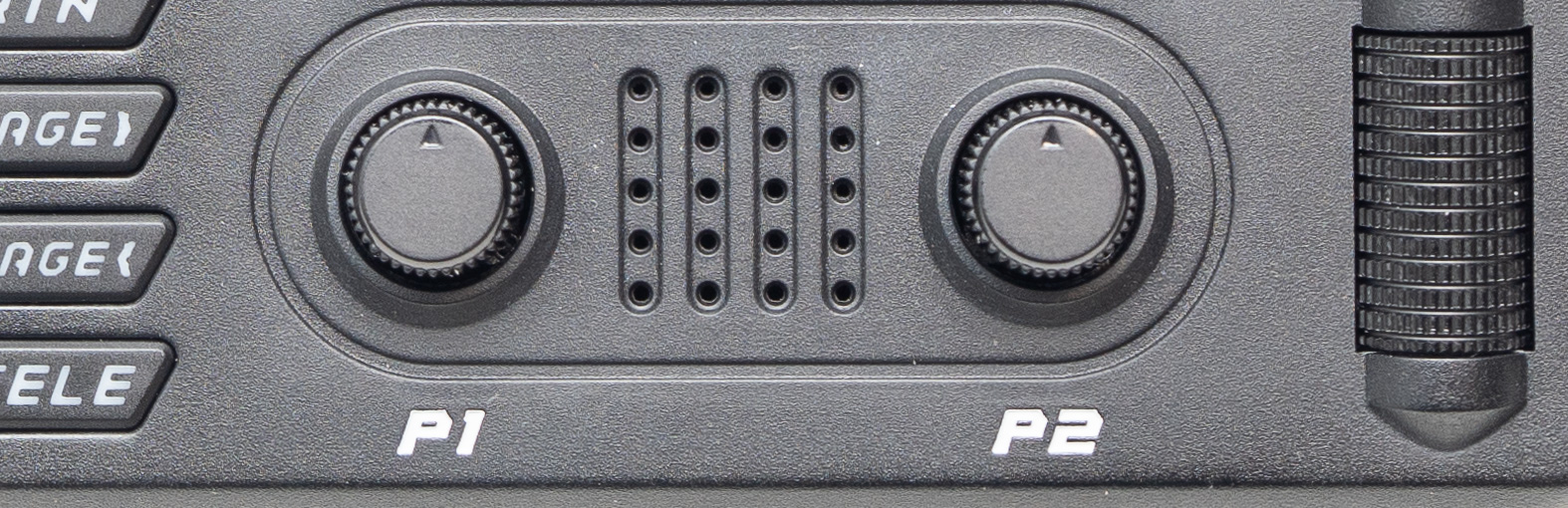
|
| Cute little pots! |
Configurable switches
Along the bottom are six switches SW1 - SW6. These have integral colour LEDs and highly configurable. The 'pad' style switches SA and SD also have LEDs and are similarly configurable.
 |
| Configurable switch array |
- A switch can act like a momentary, or push-on/push-off switch.
- A switch may be independent, or part of a group where only one switch is active at any time.
- The startup states are configurable to On/Off/As-last
- The LED colours for the on/off states can be set individually for each switch.
All very flexible! Below are some possible applications:
- Arming: push two switches together for n seconds to arm.
- Two sets of triple rates (or three sets of dual rates), with a designated default at startup.
- Flight mode selection
- etc.
In fact, the only limit is your imagination!
Gimbals
The gimbals are CNC units with multiple ball bearings and 3D Hall effect sensors.
The 3D sensors are an interesting development. There are no cables involved. Instead, the magnet, sensor and electronics are all on the main PCB. No cables means no more risk of fractured solder joints.
Folding stick
There's also a useful mechanical feature: pull smartly on a stick, and a hinged joint is exposed, allowing the stick to be folded flat. Straighten the stick, and a spring pulls it back in position ready for use. No need for gimbal protectors!

|
| Fold-flat sticks! |
The gimbals themselves are silky smooth, with a satisfying ‘clack’ on hitting the end stops.
Tension asymmetry
A small niggle: I noticed a slight asymmetry in stick tension. When moving the sticks outwards the tension is slightly weaker than when pushing inwards, especially as the end outer stop is approached. Holding the lower/inner diagonal is also easier than the higher/outer.
It's a subtle difference but it means that the overall feel is not quite as good as the excellent AG01 gimbals available for the TX16S and Boxer radios.
Adjusting the tension
The gimbal springs and friction strap are adjustable with an allen key through holes under the side cheeks. Switching between modes 1 and 2 is accomplished in a similar way.

|
| Soft springs and allen key |
Each stick's vertical travel can be altered via adjusters on the front face (remember to re-calibrate the sticks after adjustment).

|
| Access holes for gimbal adjustment |
RF module with ELRS/Gemini/Xrossband
A key feature of the GX12 is the integrated Gemini RF module. This supports single band/single frequency (regular ELRS), single band/simultaneous dual frequency (Gemini) and simultaneous dual-band (Xrossband). Supported bands are 2.4 GHz and sub-900 MHz, in all modes.
Gemini and Xrossband provide true tx diversity resulting in better link quality in areas of high interference. Note however Gemini and Xrossband do not increase ultimate range.
Currently the only Gemini compatile receiver with PWM pins is the 14-channel BetaFPV SuperP. This is quite a large device. For regular ELRS receivers such as the RadioMaster ER6G, the RF module should be configured for single or switched antenna operation.
Perhaps of academic interest for sailplane flyers: RF power is 1W max. 100mW is more than sufficient for LoS flying, so the fan will never see action for most users.
For more info about Gemini, see link at the end.
RF configuration
The following configuration will suit 2.4GHz ELRS receivers with PWM outputs such as the RadioMaster ER6G:
- Packet rate: 100Hz or 333Hz
- Switch mode: 8CH/Full
- Antenna mode: Switched or ANT1 or ANT2 (do not use Gemini mode)
- Max power: 100mW
- Dynamic RF: On

|
| Hello, bunny rabbit! |
Battery
A battery box is provided for two 18650 LiIon batteries. 21700 cells will fit if you need more capacity. Batteries are not provided with retail units.

|
| Batteries compartment incorporates a reset switch |
Charging is via the USB port at the top of the radio. Radiomaster stipulate the use of batteries with a nominal voltage of 3.7V and end voltage of 4.2V for compatibility with the internal charger.
EdgeTX
My set came with a factory build of EdgeTX 2.11.0 [edit 2026-01-15: the GX12 is now officially supported].
The usual caveats with EdgeTX apply - it's highly flexible, but the learning curve is steep. See link at end for tutorials.
Flight testing
LBT firmware was not available at the time or writing, however I sneaked in a single test session with my Sting F3F model. I used my F3F setup with crow aware trim script. Needless to say the session was uneventful.
[Edit 2026-01-15: LBT is supported in ELRS v 3.6]
Conclusion
Let's get one thing out of the way first: the Gemini RF module doesn't offer particular benefits to us sailplane pilots. This is because regular ELRS already provides sufficient interference immunity for our purposes. But in any case, there's a dearth of PWM receivers which support Gemini.
That said, there are other cool features to enjoy, such as the swappable shoulder switches, the configurable switch array, and the folding sticks.
There are a couple of negatives, though. A bit more height on the case would I think improve the ergonomics, as would an option to replace the momentary buttons on the shoulders. Most concerning, however, is that the screen struggles in sunlight.
So, will the GX12 displace my TX16S as my new daily driver? Aside from the screen, I prefer the ergonomics of the TX16S especially with the excellent AG01 gimbals. For DLG, I'll continue to use the masterful RadioMaster Zorro. And for casual foamie flying, the Radiomaster Pocket still reigns supreme.
So who is the GX12 for? If you can put up with the screen, then the GX12 will make a fine all-rounder, if not the greatest for any particular application. One area where the GX12 does excel, though, is price: just under £170 here in the UK, which is remarkably good value considering its features.
Radiomaster GX12 specifications
- Size: 183*148*78mm
- Weight: 573g
- Frequency: 2.400GHz and Sub-G 900MHz
- Internal RF: ELRS 2.4GHz / Sub-G 900MHz
- Supported Protocols: Express-LRS
- Cooling Fan: Yes
- Antenna: Dual folding 2.4GHz/ Sub-G 900MHz omni directional
- RF: (Dual 1,000mW | Dual band XROSSBAND ELRS)
- Voltage Range: 6.6 - 8.4V DC
- Current: 390mA - 1000mA (Depending on Rf output)
- Radio Firmware: EdgeTX (Transmitter) / ELRS (RF module)
- Channels: Max 16 channels (Receiver dependent)
- Battery: 7.4V 2-cell Lithium-Polymer / Two 3.7V 18650 Lithium-Ion cells (batteries not included)
- Charging: 2s Smart Balance Charging
- Connectivity: USB-C
- Display: 128*64 Monochrome OLED display
- Gimbal: GX01 1000Hz, 3D Digital CNC Hall Effect Gimbal with folding sticks
- Gimbal Sticks: 3mm
- External Module: Nano / Crossfire compatible
- Upgrade Method: USB / EdgeTX Companion PC software
- Memory: 512Mb Integrated Flash
Links
- Radiomaster
- ELRS Gemini - explainer
- BetaFPV SuperP - Gemini receiver
- EdgeTX Clinic - EdgeTX tutorials and templates

6 comments:
Hey Mike! Regarding the ETX Companion, the RM GX12 is included in the latest nightly companion 2.11.0, but I can't answer if everything works?
As far as EU/Lbt is concerned, it could possibly be the case that if you have 10mW of power, that will be the exception for Lbt? Something you might be able to investigate/apply..
https://github.com/EdgeTX/edgetx/actions/runs/12590467261
Thanks for the heads up re Companion. Not sure if the GX12 needs CE certification to fly legally in the UK - I suspect this is the case in which case it would not be legal with current firmware, regardless of power setting. (That said, it's already available for purchase in the UK.)
@RC Soar: the GX12 is indeed illegal to use within the eu, since it lacks CE. The importer into the eu, be it a consumer or business, has the full legal responsibility to provide a valid CE document and implicitly bears all legal risks when inporting the item in the eu.
If you are able to get it at an eu business, that business will bear all risk. If the end user makes an accident using that transmitter, the businessowner that inported the product must proof that the transmitter is legal to use within the eu. If they cant, they can have a big problem . They could even held liable for accidents that users of their illegally put to market transmitters did make.
No, since theres no ce the gx12 simply may not be used within the eu, even when output power is < 10mW
Please take a photo of the 3D Hall sensor?
Getting photo access to the 3D sensor would almost certainly require special recalibration, so sadly I shall pass on that one.
Post a Comment